Pad printing pens and promotional gifts
Pens, keyrings and small gift items look straightforward until the job needs sharp registration, quick handling and a clean repeat over a long run. This page looks at how branding shops set up pad printing work for promotional products without wasting pads, ink or operator time.
Small items, tight margins, lots of handling
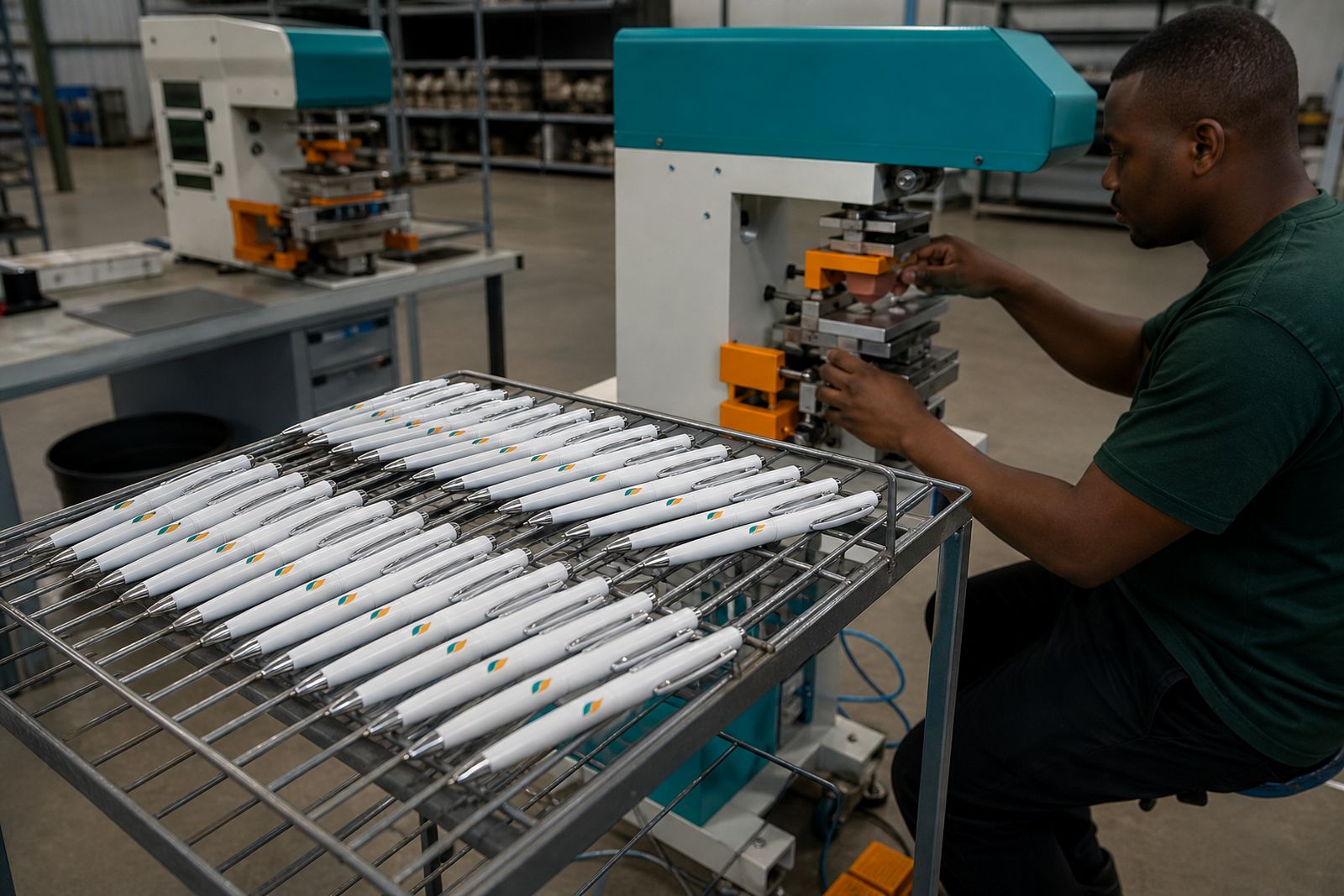
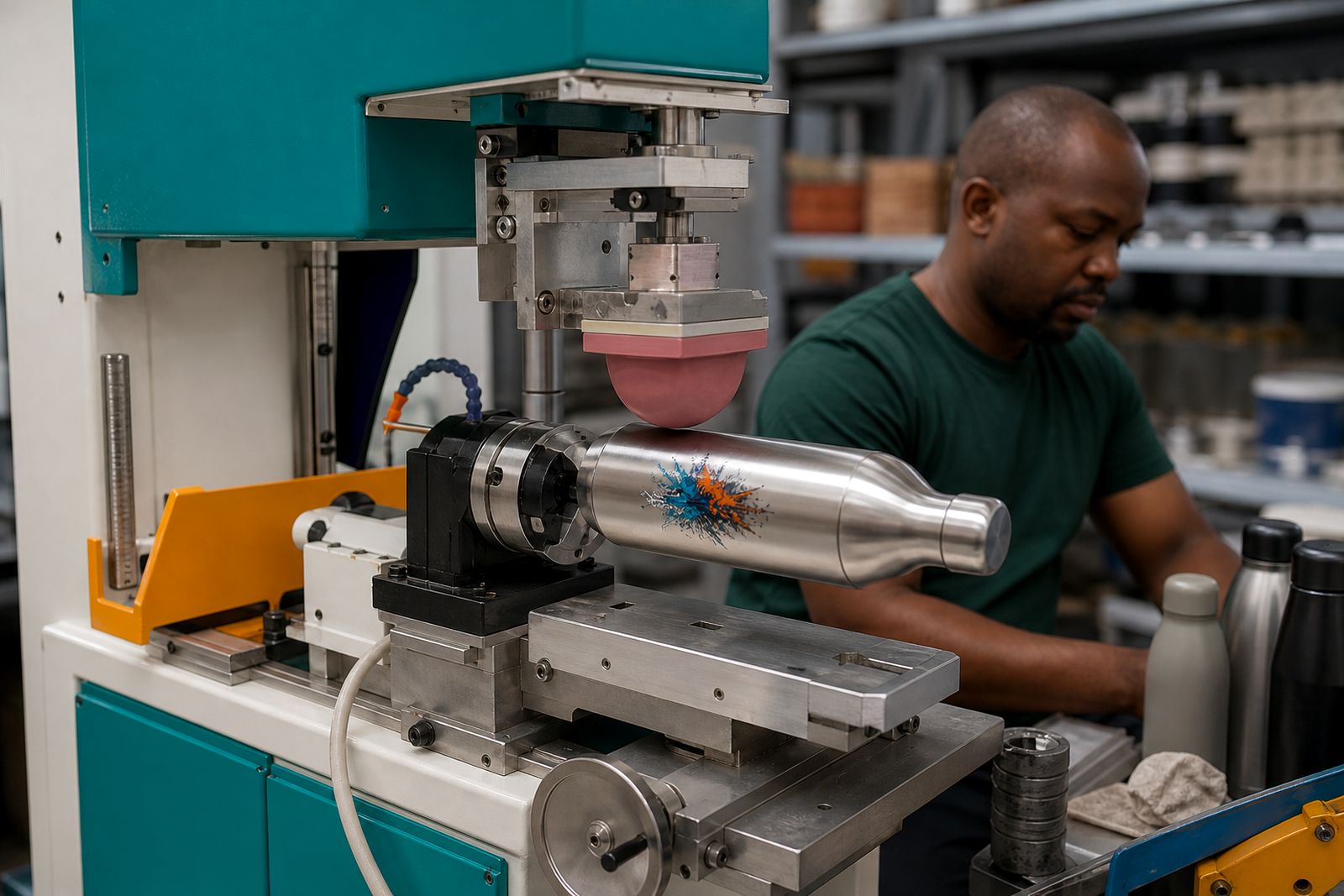
Promotional products are often small, glossy and awkward to hold in exactly the same position hundreds or thousands of times. A pen barrel can roll, a keyring face may sit slightly off-centre and a coated gift box can pick up fingerprints before the print even flashes off. That is why pad printing remains a standard machine process in branding shops handling these items. It reaches onto mild curves, places a mark in a controlled area and keeps the print position consistent when the machine, cliché, pad and jig are matched properly.
In a real production room, the challenge is not only getting one sample right. The challenge is keeping image position, colour density and handling speed steady over the full batch. On small promotional lines, the setup work often matters more than the machine cycle itself.
Where a fast pen run is won or lost
Pens are one of the clearest examples. Most branding businesses want the logo to sit straight along the barrel, read cleanly across the clip orientation and dry without offsetting when pieces are packed. A machine with a stable stroke and repeatable ink cup movement helps, but the jig is what keeps the pen from shifting between prints. If the pen sits a fraction high or rotates slightly, the whole run starts to drift.
- Use a jig that locates the barrel and controls roll.
- Set the print area in relation to the clip, not only the barrel centreline.
- Match pad shape to the curve so the image lands without distortion.
- Keep ink viscosity steady through the run, especially in dry inland air.
- Separate printed stock from unprinted stock clearly at the machine.
Shops in Gauteng often see the air change through the day, with a cool start and a warmer, drier afternoon. That can affect ink behaviour on some plastic pens. A small adjustment made early can save a lot of rejects later on, and it is better than pushing on while the print starts to look thin at the edges.
Jigs matter as much as the printer
For keyrings, token-style products, USB casings and boxed gifts, custom fixtures do much of the heavy lifting. A good jig positions the item quickly, presents the print face square to the pad and allows the operator to load and unload without fighting the part. Poor fixtures slow the run and create inconsistency because the operator keeps correcting placement by eye.
On mixed promotional work, many shops keep a set of dedicated jigs for regular product lines and then machine or build one-off fixtures for unusual jobs. This is usually more practical than trying to force every item into a universal holder. Teh item may look close enough at first, but one small movement under pad pressure is enough to spoil registration.
- Flat keyrings need positive edge stops.
- Curved gift items often need a nest that supports the full underside.
- Small lids and caps need anti-rotation features.
- Boxed sets benefit from fixtures that hold the insert or lid in the same orientation every cycle.
When the fixture is right, setup becomes easier to repeat on the next order and the operator spends less time chasing alignment.
A workshop example from Midrand
A branding shop in Midrand had a mixed promotional order made up of pens, rectangular keyrings and a small run of pocket torches. The artwork was simple, one spot colour on each item, but the substrates were different and the loading method changed from product to product. The machine itself was not the difficulty. The job only settled once each item had its own fixture and pad selection.
The pen jig was cut to hold the barrel against a fixed clip reference. The keyring fixture used corner stops to keep the face square. The torch needed a shallow cradle so the body would not twist during the print stroke. With those changes in place, the operator could keep the setup sequence tidy: test impression, adjust pressure, check image position, then run the batch in trays separated by product type.
That sort of job is common in South African branding work. A single customer order may involve several item types, packed together for an event or staff issue. If the shop tries to treat them all as nearly the same, wastage climbs very quickly.
Consumables that affect the finish
On promotional items, people often notice the machine first and the consumables second. In practice, inks, pads and plates have a direct effect on print sharpness and day-to-day repeatability. A soft pad can help on a curved item, while a firmer pad may give better edge definition on a flatter plastic piece. The plate image depth, ink type and thinner balance all play into the final result.
- Plastic pens and gift casings may need different ink systems even when the colour is the same.
- Silicone pad shape changes how the image wraps onto a curve.
- Plate quality affects fine text and solid fills.
- Clean handling between cycles matters on high-gloss products.
Operators also need a sensible bench layout. Trays for incoming stock, test pieces, approved pieces and rejects should be kept apart. On small items the print may be accurate, but the batch can still get muddled if the handling side of the station is sloppy.
Getting repeatable results on future runs
Most branding businesses do not want to solve the same setup problem every time a common item returns. Keeping notes on jig position, pad choice, cliché layout and ink mix makes repeat work easier to restart. That is especially useful for regular corporate merchandise where the item changes colour but the print area stays the same.
Machine setup and operator training help here because they turn one good run into a process the workshop can use the next time. If your shop is building a promotional range around pens, keyrings, torches, mugs or similar products, it helps to work with a team that can supply the machine, the consumables and the fixture side of the job together. For product-specific guidance, you can send the item details through our contact form.
What our Pad Printing customers say
Verified Google reviews
Questions we get asked
Can pad printing handle both pens and small keyrings on the same machine?
Yes. One machine can handle different promotional items, provided each product has the right fixture, pad choice and setup. The changeover work matters more than the item size.
Do branding shops need custom jigs for promotional gifts?
In most cases, yes. Custom jigs keep the item in the same position for every print and reduce operator correction, which is important on long runs of pens, torches, keyrings and similar items.
Do you print promotional products for the public?
No. We sell, set up and support pad printing machines, inks, silicone pads, clichés and custom jigs for branding businesses. If you need machine or consumable help, use our contact form.
Also worth a look
Tell us about the job
Send sizes, materials and where you are through our contact form, and we will come back with the practical options.
Open the contact form