

Pad printing garment labels and caps
Garment decorators usually need two things from pad printing: a clean tagless neck label and a repeatable print on awkward cap shapes. This page looks at where pad printing fits, what matters on the machine side, and how a South African workshop can keep output consistent.
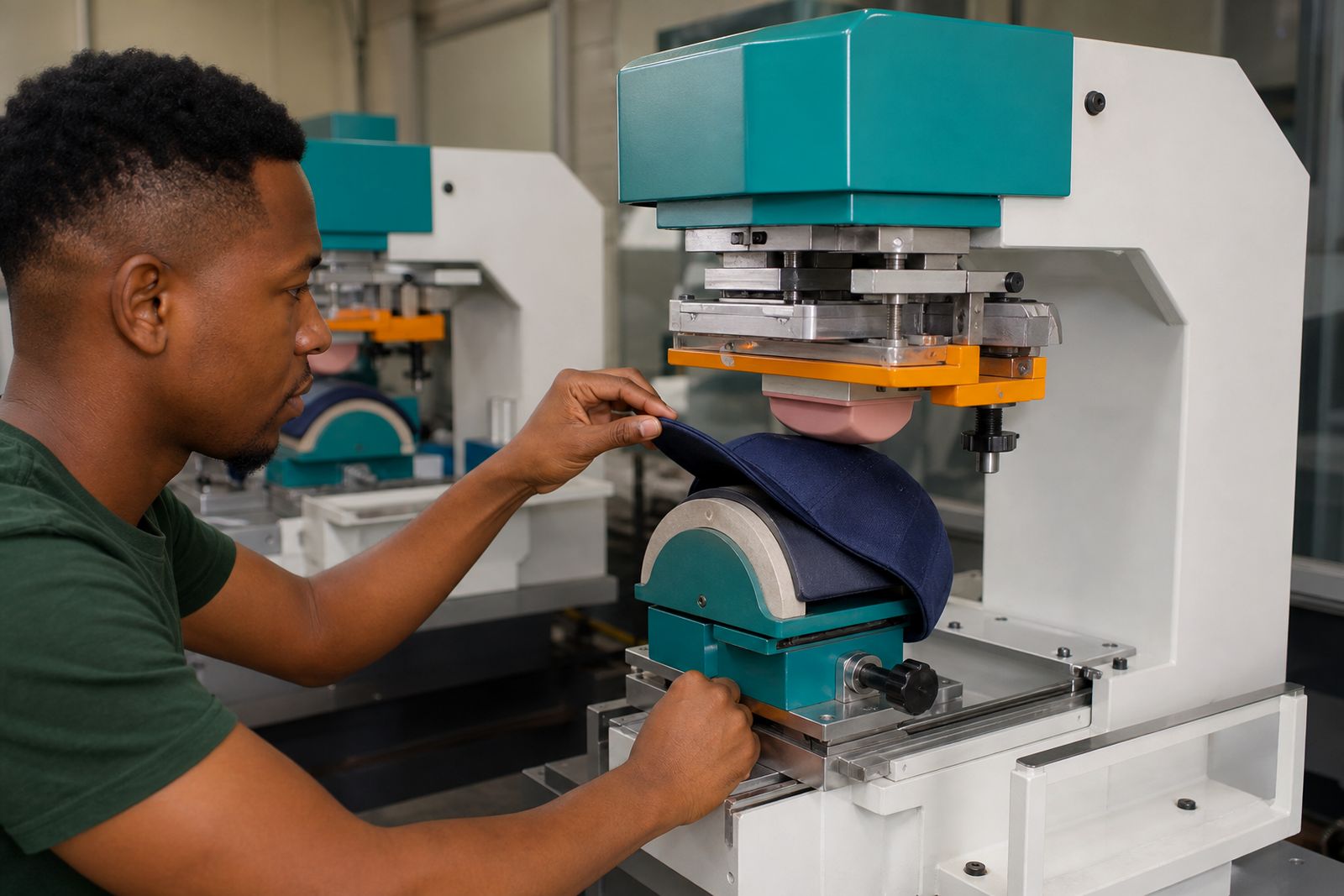
Where pad printing earns its place in garment work
Screen printing still handles large chest prints and back prints well, but smaller apparel marks often need a different approach. Tagless neck labels, size marks, care prompts, cap peaks and stitched panels can be too small, too curved or too uneven for a broad flat print method. Pad printing bridges that gap by lifting ink from the plate and transferring it with a shaped silicone pad onto a surface that is rarely perfectly flat.
For garment decorators this matters most when the mark has to sit in a tight area with neat edges. A neck label inside a T-shirt needs legible small text and repeat position. A cap peak needs the image to sit square to the seam line, even though the surface curves away on both sides. Once the fixture and pad are matched properly the process is very repeatable, but it is not forgiving of guesswork.
- Tagless neck labels on cotton and cotton blend garments
- Small size and brand marks on inside panels
- Cap peaks with single colour or multi-pass artwork
- Side panels and curved stitched sections on promotional headwear
- Short copy or icons on narrow apparel trims and labels
Tagless neck labels need more than just small artwork
Inside-neck printing looks simple until the first production run starts. Fabric stretch, lint, heat-set finishes and garment construction all affect the print. With tagless labels the real job is not only getting the artwork onto the shirt. It is keeping the copy readable after stacking, packing and wear. Ink choice and plate depth matter, but so does garment placement.
A dedicated jig for the neck area helps keep every shirt in the same position. On many runs the collar seam creates a slight rise, so the pad must compress enough to print around that area without flooding the finer text. Too soft a pad can distort the letters. Too hard a pad may miss part of the print near the seam. That balance is usually found by testing the actual blank garment, not by relying on a sample swatch.
- Use artwork with sensible line weight for fabric texture
- Check the collar seam height before choosing the pad shape
- Keep the shirt body flat in the fixture to avoid skewed placement
- Match the ink system to the fabric type and expected handling
- Run an adhesion and rub check on the actual garment batch
Neck labels also need practical copy layout. If a decorator tries to include too much legal and care information in one tiny print area the result can become muddy. In many cases a clean brand mark, size and a short origin line prints better than a dense block of text, and operators will have fewer rejects.
Cap peaks and stitched curves call for proper fixturing
Caps are where fixturing becomes non-negotiable. A peak may look smooth from a distance, yet the top stitching, sandwich piping, seam lines and crown shape all influence the print. Holding the cap by hand is not realistic for consistent work. A purpose-made fixture keeps the peak angle and registration point stable from one item to the next.
Custom jigs are especially useful when a workshop handles the same style of promotional cap week after week. The fixture can support the underside of the peak, stop the cap at a known point, and help the operator load it quickly. That saves spoilage, but more importantly it keeps the print centred where the customer expects it.
The shape of the silicone pad is equally important. A pad that lands too flat can bridge over the curve and leave weak transfer at the edges. A better matched profile rolls the image onto the peak progressively. That often gives cleaner solids and less distortion near the outer edges, even on a fairly domed peak.
A Midrand workshop example from a mixed apparel week
One Midrand branding workshop might spend the morning printing one-colour neck labels on a run of promotional T-shirts, then switch after lunch to cap peaks for a retail activation. The neck label job needs a simple inside-neck fixture, a plate set for fine text and an ink mix suited to the garment fabric. The cap job needs a different jig entirely, with the artwork referenced from the centre seam and the stitching pattern checked before production starts.
In that kind of week the operator usually gains more from organised setup than from sheer machine speed. Keeping separate pads for label work and cap work prevents unnecessary compromise. Label prints often favour a pad that resolves smaller detail, while cap peaks may need a shape that follows a wider curve. When the workshop treats these as two different jobs instead of one general pad print task, output is steadier and rework drops.
Gauteng winter air can dry ink differently to a humid coastal day, and that shows up quickly on small apparel marks. A workshop sending finished work to Durban or Gqeberha will often check cure and rub resistance carefully before despatch, because packed garments and stacked caps create their own abrasion during transport.
Setup points that make the difference on the floor
A good result usually comes from a handful of small decisions made in the right order. Machine size, artwork layout, plate quality, pad hardness and fixture support all feed into the same outcome. If one of them is out, the operator will spend the run chasing registration or ink transfer problems.
- Start with the exact blank item that will be printed in production
- Set the fixture first, then centre the artwork to the real loading position
- Choose a pad profile that suits the surface curve, not just the image size
- Watch for stitching channels that can break fine lines or type
- Keep test prints from approved setup beside the machine during the run
- Separate label inks and cap inks if the substrates behave differently
For smaller branding businesses choosing a first machine, apparel add-on work often sits well on a straightforward single colour unit. If the cap artwork needs layered colours or a tighter two-position sequence, a more advanced configuration may be the better fit. The main point is to match the machine to the real mix of work rather than buying around a once-off job.
When to ask for machine, pad and jig advice
Garment decorators moving into pad printing usually know their products well but need help matching machine setup to those products. That is where practical support matters most. A workshop printing labels on tees is dealing with different variables from a business marking plastic pens or mugs, so the recommendation should follow the substrate, print area and daily workload.
Pad-Printer works from Midrand, with machine setup and support across Gauteng and courier supply to every province. We supply pad printing machines, inks, silicone pads, cliches and custom jigs for branding businesses, including shops that handle apparel labels and caps. We do not print branded items for the public. If you need guidance on a neck label layout, a cap fixture, or the right machine for mixed promotional and garment work, send the details through our contact form.
What our Pad Printing customers say
Verified Google reviews
Questions we get asked
Can pad printing handle very small text on tagless labels?
Yes, provided the artwork is suited to the fabric texture, the plate is prepared properly and the pad is chosen for fine detail. Very dense text on a soft or uneven garment surface may need the layout simplified.
Do caps need a special fixture for repeatable printing?
In most cases yes. Cap peaks and stitched panels vary in shape, and a dedicated jig helps keep position, angle and loading consistent through the run.
Is pad printing only for one colour apparel marks?
Not only. Single colour work is common for neck labels and cap peaks, but multi-colour jobs can also be produced where the artwork, registration and machine configuration suit the item.
Also worth a look
Tell us about the job
Send sizes, materials and where you are through our contact form, and we will come back with the practical options.
Open the contact form