
Four colour pad printer
Our four colour pad printer is built for branding shops that need repeatable registration on promotional items with more than one ink colour. It suits trade work where a single pass through the machine is not enough and the logo needs proper layering across small curved or uneven surfaces.
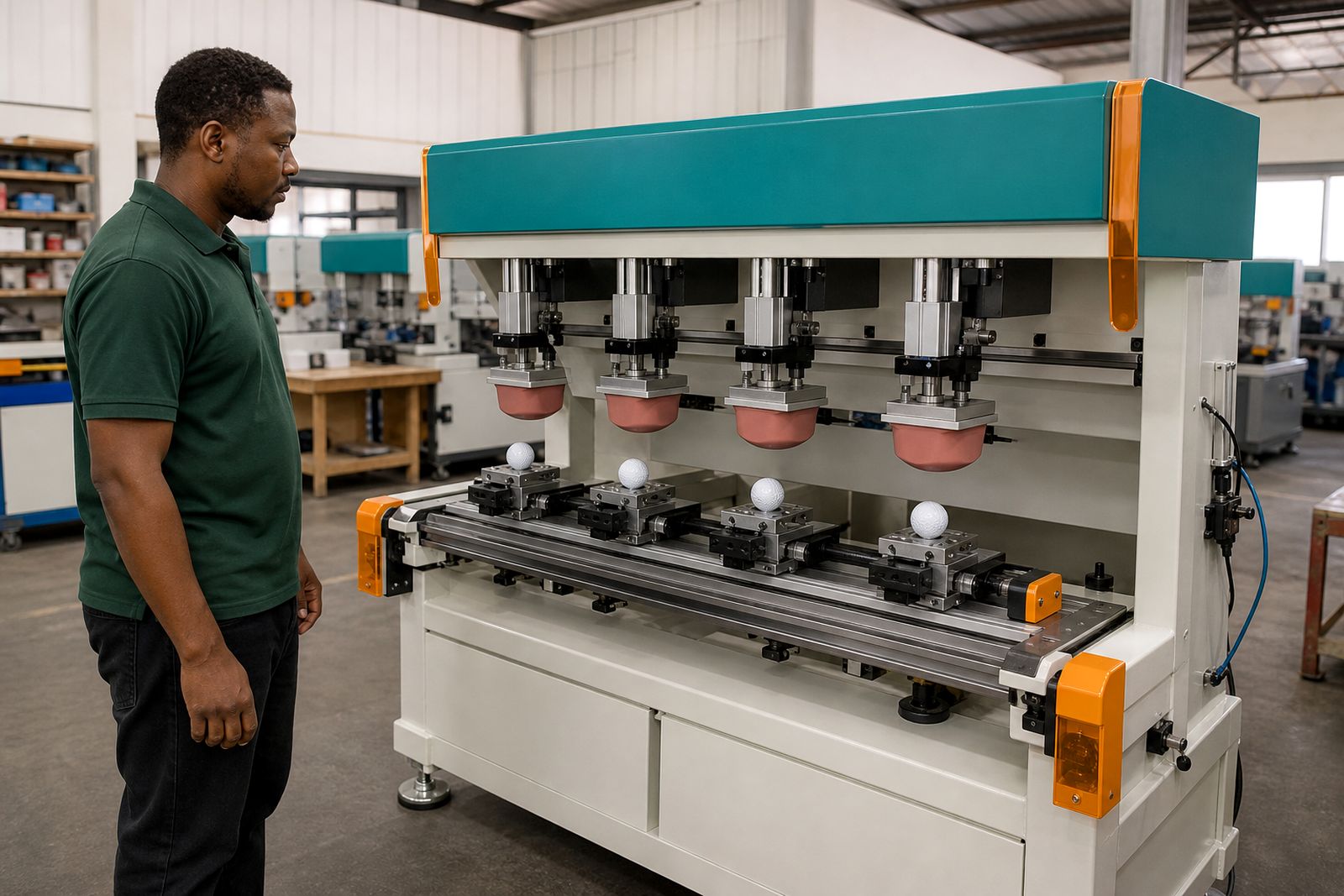
Built for logos that need four passes in sequence
A four colour pad printer carries the item through four print stations so each colour lands in the correct position on the same setup. This makes it the practical choice for promotional branding businesses printing company marks, sports motifs, safety icons and retail artwork where one or two colours will not do the job.
The machine uses a separate ink cup, plate and pad position for each station, with the shuttle or indexing movement keeping the part aligned between prints. On pens, labels, caps and smaller drinkware this saves a lot of handling and reduces the drift you get when an operator must reload the item for every colour. The result is neater registration and less wastage once the job is dialled in.
We sell, set up and support these machines for South African branding businesses. If you are buying for in-house production, we can match the pad shape, plate size and fixture layout to the items you print most often.
Print area, item sizes and working limits
The right machine size depends on the artwork footprint and the shape of the product, not only the outside dimensions of the item. A mug may be large overall but the safe print panel is still limited by its curve, handle position and the travel of the pad.
- Typical print areas range from about 60 x 60 mm on compact promotional goods up to around 100 x 150 mm on larger fixtures.
- Pen barrels, cosmetic tubes and bottle lids usually need narrow artwork and a pad shape that can roll gently over the curve.
- Caps and garment labels often need a flatter fixture face with careful support under the print zone.
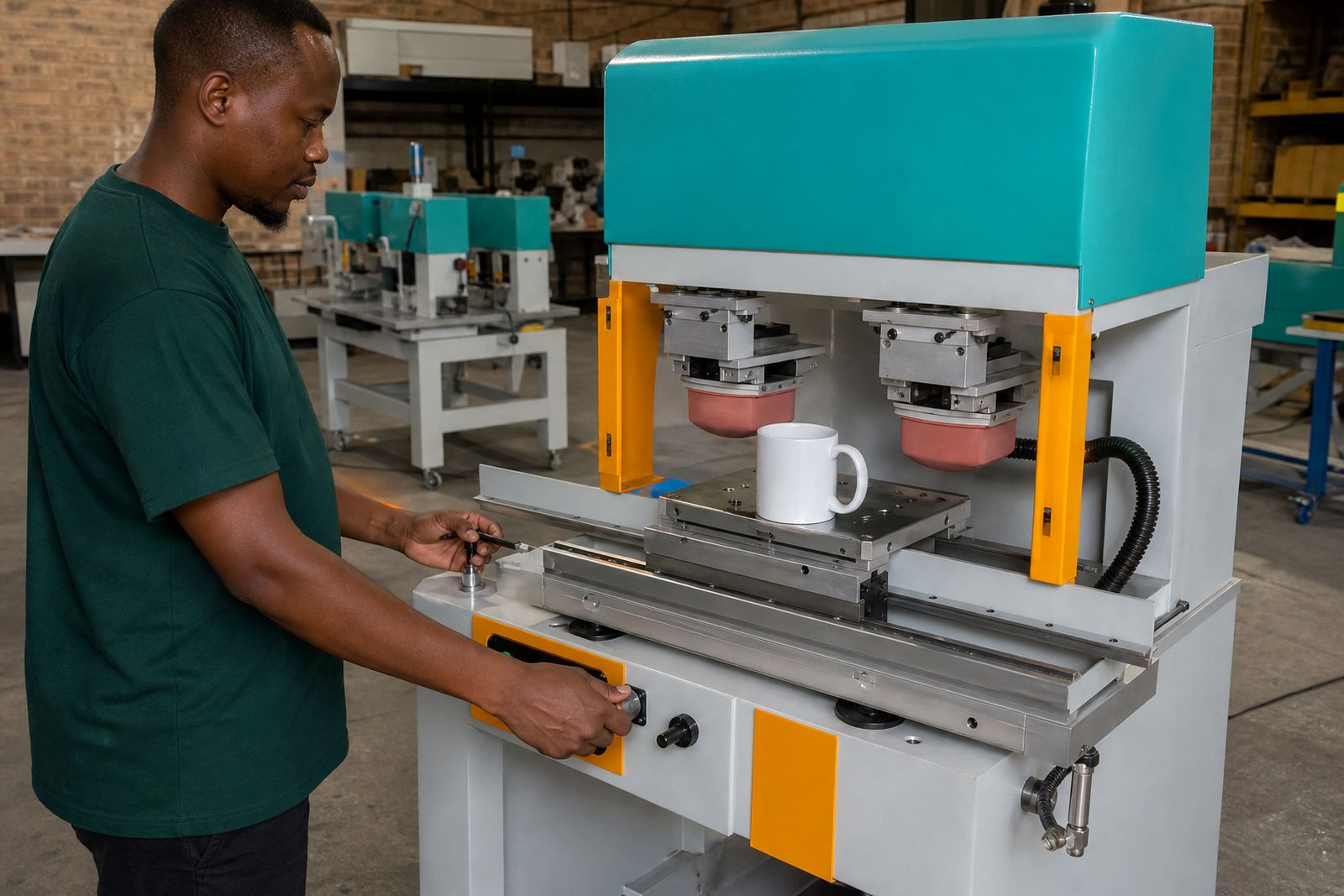
- Mugs, bottles and curved gift items can be done when the logo area is sensible, but a full wrap is outside the scope of pad printing.
- Fine text and keylines are possible, though very soft silicone pads and deep curves can distort tiny detail a bit.
Four colour work is best where the image is compact and the artwork can be separated cleanly into spot colours. Large flood areas, photographic blends and very long prints are not where this machine shines, and it is beter to say that upfront than force the wrong process onto the job.
Jobs that suit this machine, and jobs that do not
This machine earns its keep in a trade shop handling repeated logo work on promotional items. If your orders include pens, keyrings, garment labels, caps, small cases, bottle tops or branded accessories with two to four spot colours, a four station setup gives you more control over alignment than a single station machine.
- Good fit: multicolour logos on pens, labels, caps, drinkware panels and small moulded parts.
- Good fit: repeat runs where a fixture can hold the item in the same position every cycle.
- Less suitable: oversized artwork, full wraps and very high relief surfaces.
- Less suitable: one-off public jobs where the setup cost outweighs the print run.
- Less suitable: photographic imagery better handled by other decoration methods.
If most of your daily work is one colour on simple stock, a single colour machine may be enough. If you need two colours on faster repeat production a shuttle model can make more sense. The four colour format is usually chosen by shops that already know the value of tighter registration and want to keep more demanding logo work in-house.
Space, air supply and installation in a real shop
The machine needs a level floor or sturdy production bench, stable compressed air and a clean area where dust will not contaminate plates or wet prints. Good lighting matters because operators must check registration marks, pad pickup and ink coverage all the time. A crowded back corner tends to create avoidable setup errors.
For most installations in Gauteng, the important site questions are bench height, air line condition, room around the machine for loading fixtures and safe storage for inks and thinners. In coastal towns we also look at humidity and general solvent handling, because ink behaviour can shift across the day if the room is too damp or too hot.
- Compressed air must be dry and stable for consistent pad stroke and shuttle movement.
- Mains power is required where the model uses electrical controls and curing accessories.
- Ventilation should be sensible for solvent based consumables used during printing and cleanup.
- Allow room for plates, pads, jigs and finished parts beside the machine.
We install and set up from Midrand across Gauteng, and machines plus consumables can be sent to every province with the right packing and handling notes.
Looking after registration, pads and plates
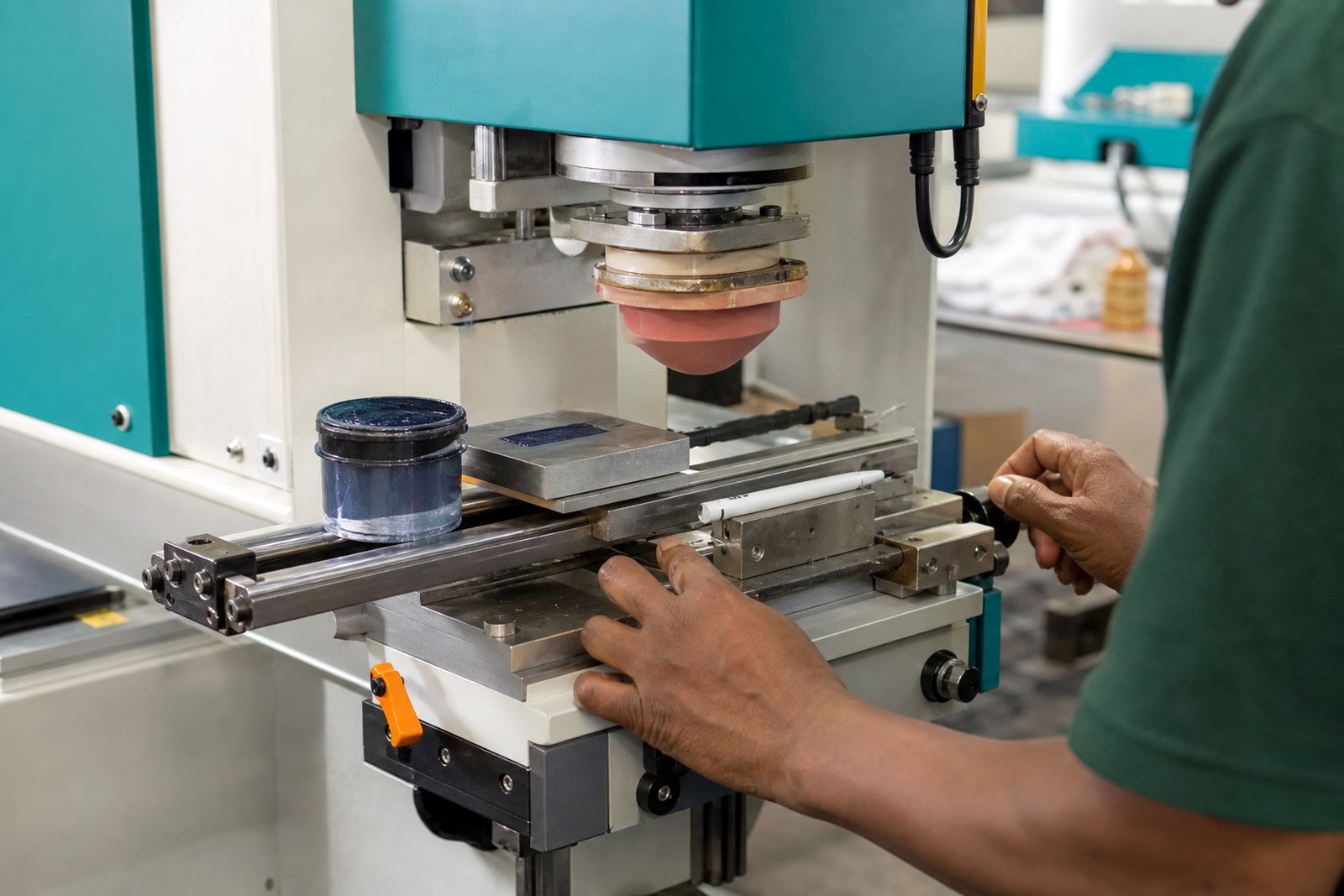
Four colour output depends on clean habits. Plates must be protected from scratches, ink cups kept free of dried buildup and pads stored away from heat and dust. When a print starts losing edge definition, the cause is often simple: tired ink mix, a damaged pad face, or a fixture that has picked up wear and lets the item move a fraction.
Daily care is not complicated, but it must be done properly. Wipe down exposed areas, check cup rings and watch the first few prints of every shift with care, because that is when small registration drift usually shows itself. Operators who rush colour changes tend to create more waste than they realise.
We also supply the working parts around the machine, including inks, silicone pads, cliches and custom jigs. That matters because the printer body on its own is only part of the system.
What to send when you ask about a four colour machine
The more closely you describe the item and artwork, the easier it is to point you to a machine size and fixture plan that will actually work on your floor. Send the details through our contact form and include clear photos where possible.
- The product type, material and approximate size in millimetres.
- The print area size and whether the surface is flat, tapered or curved.
- The number of ink colours and whether any colours must overlap tightly.
- Expected run quantities, from short promotional batches to longer repeats.
- Whether you need custom fixtures, spare pads, extra plates or setup help.
- Your town or province if installation or courier planning is part of the brief.
If you already have a sample item and vector artwork, mention that as well. That saves guesswork and helps us advise on pad hardness, plate size and jig layout without sending you in the wrong direction.
What our Pad Printing customers say
Verified Google reviews
Questions we get asked
Can a four colour pad printer print photographs?
It is intended for separated spot colours rather than photographic full-colour imagery. If the artwork relies on gradients or very large shaded areas, another process may suit the job better.
Do I need a custom jig for every product?
In most cases yes, especially when registration between colours matters. A proper jig holds the item in one repeatable position and reduces movement between stations.
Is this machine suitable for public walk-in printing?
It is aimed at branding businesses running their own production. We sell and support the equipment, consumables and setup rather than printing finished promotional goods for the public.
Tell us about the job
Send sizes, materials and where you are through our contact form, and we will come back with the practical options.
Open the contact form